Amsterdam
The Reincarnationist PapersAmsterdam is where Emil Restoud’s encounter with Jan Vermeer became a portrait, a relationship, and a bond to a work of art that endured for centuries. The city’s significance rests less on a wider civic history than on two closely connected settings: the address where Vermeer painted Emil and the home where the finished portrait remained until it was stolen.
Commission and Meeting
After arranging the commission at an address in Amsterdam, Emil received Vermeer one week later. He arrived punctually with canvas and supplies. Over lunch, he spoke of his background: he had studied with no one and could not explain his natural talent. They continued talking until sunset, when the light was too weak for him to work, and Emil put him up in a guest room so they could begin early the next morning.
The Portrait and Their Relationship
Vermeer worked slowly and with sustained attention to detail. The portrait required a week of sessions lasting ten hours a day, with Emil holding the same position for long stretches. When Emil tried to shift discreetly, Vermeer would set down his brush, come over, and gently restore the pose. Emil began shifting deliberately to invite that attention; by the fourth day, they had become lovers. Vermeer called the painting The Rendezvous, a title that acquired a personal meaning beyond the meeting it depicted.
The Amsterdam commission also became the beginning of a continuing exchange between the two. In the fall of 1674, Emil bought three more of Vermeer’s works for five hundred silver francs apiece, and Vermeer delivered each one personally. He died the following year, leaving the portrait as a lasting connection to a relationship cut short.
The Painting’s Long Residence
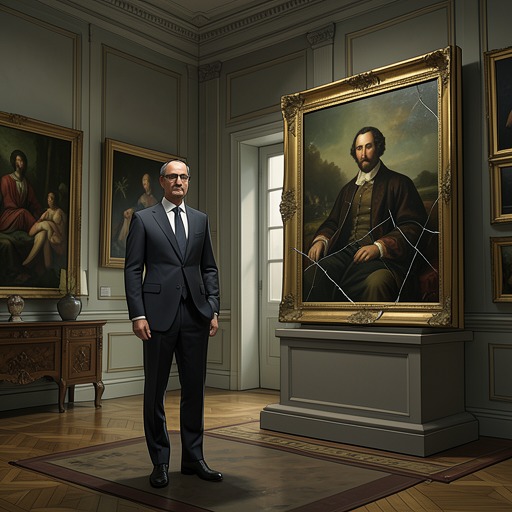
The Rendezvous was the only portrait Emil had of himself as Emil Restoud. He kept it in his Amsterdam home for more than two hundred and fifty years, hanging it in the same room where Vermeer had painted it. The painting’s location thus preserved not only an image of Emil but the history of its making: the room, the model’s chosen pose, and the artist whose approach had made the commission intimate.
When the painting was taken from the wall, Emil described the loss as the loss of a part of himself. Amsterdam is therefore bound to the work’s two forms of presence: first as the place where the portrait and relationship began, and later as the home that kept their material trace for centuries before the theft severed it from its owner.